
There is no such thing as being a ‘perfect’ parent—it’s human to make mistakes. However, some decisions and parenting methods have a far more negative impact than others. And if those mistakes occur frequently enough and pile up, you might hear folks whispering about what a bad parent someone is. Unfortunately, in some cases, that reputation is entirely justified. And these people’s kids are left to deal with the emotional fallout for years and even decades to come.
Redditor u/VastPurpleSky asked people to take a look back at their childhoods and share the things that they now realize were examples of truly bad parenting. Read on for their open and honest stories.
We got in touch with the author of the thread, u/VastPurpleSky, and they shared their thoughts on parenting red and green flags. Read on for our full interview with the OP.
#1

Three words:
“Boys dont cry.”
I dedicate this comment to my school counselor and my PE coach who both helped me get off the road to becoming a psychopath by telling me very much so that boys can and do indeed cry.
When it comes to parenting, there’s no one-size-fits-all approach. A lot depends on each individual family, the local culture and customs, and everyone’s relationships with everyone else at home.
So the advice that might help one family become closer might accidentally spark more tension in another. It’s essential to be very careful before making blanket statements about how (not) to raise kids—there are subtle nuances once all the basics (shelter, food, education, emotional support, etc.) are taken care of.
But broadly speaking, according to researchers, there are four main parenting styles, and one of them stands out from the crowd as the best approach.
#2

Made us feel like they were doing us a favor by raising us. For a long time I felt like I was always indebted to my parents and nothing I could do would ever be enough.
#3

My family still believes beating a kid is a great form of discipline instead of just sitting down with and talking to your child. Who would’ve thought that Beating your child when they’re young, and barely getting to know them when they’re a teenager, would lead to them almost never reaching out to you when they’ve grown up and moved out? Mind blowing right??
Also, I absolutely CANNOT stress enough how important it is to show up to your child’s extracurricular activities. I played tennis all 4 years of high school and did marching band as well and I can count on 1 hand how many times they even bothered to show up. Your job is never going to remember you worked there, but your child will *always* remember you *weren’t* there.
The four parenting styles are authoritative (the one you should aim for), permissive, authoritarian, and uninvolved (aka neglectful). The latter three are the ones that can potentially cause the most issues for kids growing up. For example, authoritarian parents have a “my way or the highway” approach, don’t consider their children’s feelings, and expect them to follow their rules to the letter, without question.
However, this focus on obedience and punishment can lead their kids to develop self-esteem issues or even develop anger problems, Verywell Family notes.
Meanwhile, uninvolved parents expect their kids to raise themselves which can also lead to self-esteem issues further down the line. They tend to ignore their children, how they’re doing at school, and who they’re friends with. They simply don’t spend quality time with their kids or at home. As a result, there are often few rules that need to be followed, and the munchkins don’t get the guidance and attention that they need and want.
#4

Nothing I did was good enough. Like, if she asked me to fold laundry and I’d do it, and then she’d redo it because I guess I folded the towels wrong. I’d clean my room, she’d come in and redo everything I’d done. And she wouldn’t teach me how she wanted things done, she’d just send me away and tell me she’d do it herself. Taught me that I shouldn’t even bother trying to help because she’s just going to redo whatever I did anyway, because I guess I was just a failure.
#5

All the weight comments. I was always a chunky kid and definitely needed/need to lose the weight, but I’ve never been able to shake the idea that I don’t deserve to be loved, because of those comments. I can always look down and see 50 extra reasons to hate myself
#6

They werent bad parents at all, but:
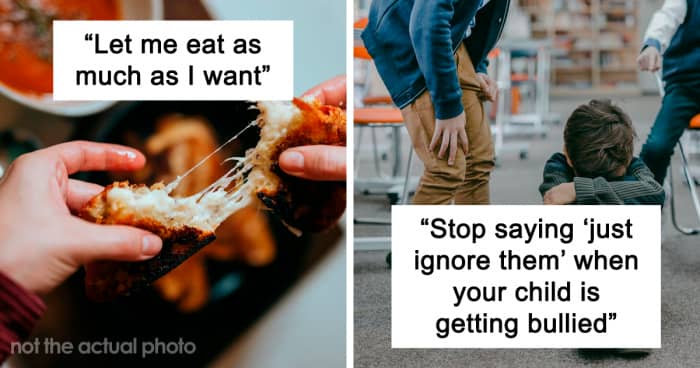
Stop saying “just ignore them and theyll get tired of you” when your child is getting bullied
It doesnt work. Your child will just be a punching bag. I did however break somones foot in 5th grade and never got bothered again.
Permissive parents, on the other hand, might set some rules but will rarely enforce them. They believe that it’s best to interfere as little as possible in their kids’ development, so they’re very lenient and don’t set healthy boundaries for (in)appropriate behavior. In short, these parents are more like friends than caregivers. And their children may have a lot of issues learning at school, following rules, and listening to authority figures.
Authoritative parents, however, focus on the best aspects of the other styles. They strive to create a balance between rules and support. These parents set and enforce boundaries but also consider what their children think and how they feel about certain situations. What’s more, they explain why it’s necessary to have certain rules: there’s an emphasis on constant, clear communication.
As a result, kids raised in authoritative (rather than authoritarian) households are more likely to grow into responsible, happy, successful adults, who feel fine expressing their opinions and thinking for themselves.
#7

Why can’t you be like…….?
#8

Buy ramen instead of nutritious food so that they could afford more cigarettes.
Mercilessly mock our insecurities and then say they were “just joking” and that we needed to “toughen up” when we got upset.
Refuse to apply for Medicaid or foodstamps because they weren’t “trashy” and let me and my sister go sick/hungry for their pride. (This one makes me extra angry because as an adult now I know they qualified and also my maternal grandparents were well off and could have helped but my mother would rather starve than accept their scrutiny)
#9

I’ve always known
I asked my mom if she was proud of me. She said I hadn’t done anything for her to be proud of.
I was 12.
According to the author, they started up the thread because they were curious about “how others perceive their parents after they’ve grown up.” They also had a more practical reason for asking the question, too.
“I was trying to farm and get to a certain minimum amount of karma, so that I can post on a subreddit. So I wanted to ask something that is relevant to everyone and start a conversation,” u/VastPurpleSky told We.
According to the OP, the biggest red parenting flag is the neglect of the children’s welfare. The redditor shared their thoughts on parenting extremes in Asia, too. According to them, authoritarian parents “expect their child to be the top student in school so that they have better prospects in the future” and also compare their children to other kids.
“I guess it’s okay to get the best out of the child, some kids can handle it but for those that can’t, the parents have to take a step back and look out for the child’s mental well-being. It’s a huge red flag when the children feel overwhelmed and the parents are completely oblivious or worse ignore it,” the OP said.
#10

Learning at an early age to bottle up emotions and not to show any. No one can hurt you if you don’t feel. Growing up, I was constantly needled about my emotions. I was only child, and at any point I wasn’t acting as they thought I should they’d basically bully and make fun of me until I either broke and cried, to which I’d be disciplined, or just go numb. Now as a adult I’m my mid thirties, I’m emotionally stunted and have a difficult time connecting with anyone emotionally.
#11
My mom raised me to believe that what other people think of me is more important than than what I think of myself. Every action had to be accompanied by a thought of how it would affect the family (i.e. her). So of course I became depressed because I don’t want people seeing me doing something “wrong”. Even this response has been rewritten a couple times because I can’t stop myself.
She’s recently complained about how I never talk to them and I’m pretty sure this is gonna be unloaded this weekend.
#12

They didn’t allow me to go out with my friends at all. I was basically grounded by default. My weekend schedule was jam-packed with various lessons. As a result, I took longer to develop social skills.
However, some parents choose to be largely uninvolved in how their kids grow up. “In Singapore, there’s a high cost of living and bringing up a child costs a lot, hence both parents have to work to support the family,” u/VastPurpleSky explained.
“Neglect would cause the child to go astray when they become a teenager, so they might join a gang, purposely get low grades, or create trouble in school to gain the attention of their parents. Personally, I feel that neglect is worse than authoritarian parenting as there’s no display of love and lack of attention where the child needs it most.”
Meanwhile, redditor u/VastPurpleSky shared their thoughts on what they think are some signs of a great parent. “To me, it’s the intention for the child that counts, and the awareness of the child’s limitations, not pushing them to meet the expectations of the parents or society. And, of course, love and support from the parents instill confidence in the child,” they told We.
“Sometimes, kids can be lazy and unwilling to push themselves to become their best version and tend to give up easily, hence the parents are there to help them realize their true potential. [They] push them further to help their children become their best selves.”
#13

Never ever said to me “. I love you”. Seriously, how f****d is that?
#14

My parents moved house basically every other year. For them it was a new job, new opportunities … for me it meant regularly losing all my friends, new school, etc. I never built up a circle of friends and have problems to do so until this day.
When I had a kid, I made sure she can go to the same school from kindergarden to the final exams (which start next week, BTW), so she doesn’t have to go through this.
Now she’s very keen on finally getting to know a different environment when she’ll start uni in autumn. Probably she’s around here, complaining that her parents stayed at the same boring place all her life… 😉
#15

my dad trauma dumped all these really dark and twisted details of what he went through on me as if I was his therapist
According to the OP, it would be wonderful if parents “are able to gauge their children’s ability properly and help them fulfill their aspirations without putting their thoughts and expectations too heavily into them and allow them to grow within their capabilities, and at the same time instill and cultivate good moral values in them.”
What’s also crucial is that parents have good intentions and show their kids that they love and support them. “Spending time with them and showing up and encouraging them during their time of need is really important!”
However, the redditor pointed out that, at the end of the day, it’s hard to say what makes a great parent. “I’ve heard of people thanking their tiger mom only after they have grown up, and looking back, they can understand why their parents did what they did.”
#16

responding with “do this because I said so”. seems harmless, right? it can teach stubborn kids respect and obedience. My mom would often use it. I wasn’t allowed to question things or point out mistakes. Now as an adult, I developed an inferior mindset. I’m often extremely obedient when interacting with people. I find it hard to find my own voice
#17

my dad would always buy my brother and i whatever we wanted if he hit or yelled at us. realizing now that i’m older it was just so we didn’t tell our mom
#18

Read my diary
#19

Laughing at me for various s**t even though they were joking. Music, hobbies, girlfriends, my body. I understand they were joking but it took a lot to get my confidence back and they also wonder why I don’t tell them anything about my life.
First – Being inconsistent. One day mom would overly obsess about my homework, or how clean my room was, or what I was going to “do with my life”, etc., the next day it was all forgotten as if it never happened.
Second – If I mentioned wanting to do anything, I was given a long list of why it could and would go wrong to the point where I felt beaten down and didn’t want to do it anymore, then I was accused of never sticking to anything.
Third – Telling me I wasn’t trying, or not trying hard enough, when in reality I was trying as best I could. It simply made me realize that there was no point in my efforts, so why bother at all.
#21
Growing up my father micromanaged everything to a point that he would decide how much time the window in my room will remain open, I wasn’t allowed to open or close the window as I wish. This goes for everything, I had to take his permission for every little thing, I had no free will home was basically a military camp. I felt so suffocated in that house.
#22

Lots of yelling and bulling, spanking, then go to church like a good little Christian family wtf 🤷♀️ very confusing upbringing that’s all I’m saying
#23
Ignoring my autism diagnosis and acting as if I’ll be fine in life if they treat me as they did my siblings. Turns out, a huge part of learning to navigate the world when you have autism involves learning coping strategies (that sometimes might not work for most people) and thus I was pushed into situations that caused meltdowns but without any coping strategies that actually worked I just became an anxious and depressed mess.
#24

Making promises and not following through on them.
#25
They stayed together “for me”, my mum made me her therapist at the ripe age of 10, my mum talked to me about our bad economy, my mum wouldn’t teach me how to talk care of myself at all until i was 16, my dad laughed and made fun of me when i failed at stuff, my dad used to jokingly almost drown me and put me in situations where i was afraid, my dad would call me a pig for eating a lot, my mum always felt the need to point out my acne even when i didn’t ask, they fought in front of me and used me to their advantages in the arguments, they only ever congratulated me when it came to grades and sports. When i was younger i never realised how bad all this was because it was all I knew, it wasn’t until I was 16 i realised how f****d up it all was
#26
had money but never let us kids have regular medical check ups/ never got us braces no matter how bad our teeth are and said its our responsibility to do those things when we’re older :// They did horrible things but this realization often made me tear up. For context, I have a lifetime illness that needs checking up every 3 months
#27
So I just want to preface this by saying that I had a good childhood, my parents loved me, and I believe they really did try their best.
One of the things they did that I think is bad parenting is they constantly tried to make sure things were “equal” between me and my siblings. For example, for awhile they experimented with paying us extra allowance for good grades. I was always good in school, so I almost always ended up with all A’s, so I got a lot of money. My sibling was (and still is) a lazy f**k so they would hardly get any except for PE. Despite that, my parents found ways to “even things out” so they would still have some spending money. It created an incentive for my sibling to continue being a lazy f**k, and disincentivized me working hard. I still did because I wanted to go to college, but it definitely created animosity.
I think parents should treat their kids equitably, but children are not equal and should not be treated like they are equal. Each is an individual with their own strengths and weaknesses, and what works for some may not work for others.
#28

They isolated and neglected me.
#29
– Never gave me any encouragement to do anything. Anything I wanted to do was met with negativity and criticism. Looking back, I think they were trying some reverse psychology b******t, but I’ve never worked that way and now I just don’t try to do anything, really.
– My Dad was the youngest of three brothers which obviously made him think that little brothers are naturally superior and always told him that he didn’t have to listen to me or do what I said. Which baby brother took as wholesale permission to do whatever he wanted – go to my room and start wrecking s**t, take any of my stuff he wanted, etc and if I told him to stop it’s always “I don’t have to listen to you! I don’t have to listen to you! Ha ha!” Unsurprisingly he also ended up getting into trouble at school a lot. We had a really bad relationship until I moved out for University.
– Used to punish me for telling the truth, which just led to me lying and hiding things and never really telling them anything at all to be honest.
#30

Letting the TV be a babysitter.
#31

Let me eat as much as I want, to the point that I weighed 131kg at my peak. Losing all s**t is hard man. But I’m down to 94kg now and let me tell you, there is no possibility that my future kid(s) will ever be obese.
#32

Giving my brother a present on my birthday.
#33

My parents weren’t bad parents but I would say they were kind of benignly neglectful. I was clothed and fed and loved but not guided in any way at all. Everything was up to me. If I did homework, if I brushed my teeth or bathed. if I went to school, applying for college. Luckily I’m pretty naturally a rule follower and self driven or who knows how I would have turned out.
#34

Put a lock on my bedroom door
#35

Completely shut down any kind of relationship conversation. It was a blanket “no”. Not up for debate. Ok, I grew up in a pretty conservative part of the world but that’s not an excuse to treat having a boyfriend as sacrilegious. ( In my all girl’s K – 12 school, a student could get expelled for talking to a boy over the school wall. )