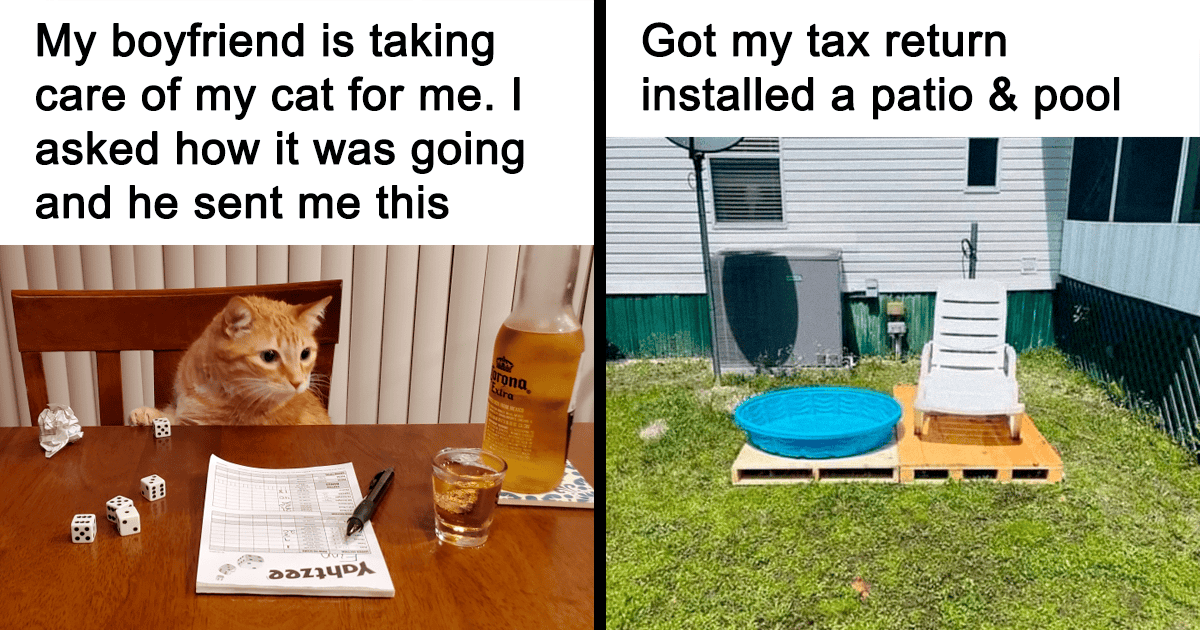

Every now and then, we all need some lighthearted content to lift us up. In a world ruled by media overload and an abundance of bad daily news, it’s easy to feel mentally drained.
Recently, psychologists saw the emergence of terms like “doomscrolling,” “headline anxiety,” and “headline stress disorder” which refer to a growing amount of people suffering from the psychological strain of living through and absorbing dismal news.
This lighthearted Facebook group “Funny As Heck” is anything but that. Dedicated to making people’s moods better, it offers a daily stream of hilarious memes and posts that range from utterly absurd to pretty relatable. Below we wrapped up the funniest examples for us to enjoy, so upvote your favorite ones as you scroll!
#1

#2

#3

What we find funny or not really depends on the person. But it turns out that getting a joke requires quite a lot of cognitive and social skills, which we previously spoke about with Paige Davis, a senior lecturer at York St John University who specializes in developmental psychopathology and developmental psychology.
“The thing is, even babies pick up on social cues,” Davis said. “If you’ve ever seen a baby start to join in laughing when everyone is laughing you will know this, so even if they may not understand the meaning of a joke, they will understand that the atmosphere in the room has changed and everyone is laughing.”
#4

#5

#6

Essentially, our sense of humor develops along with social understanding. This is when we learn we are social beings in a world of other social agents. According to Davis, “Non-verbal humor is usually developed first, so an example of this is when my youngest son had been walking for a bit (15m). If he ran into something, my partner would pretend to run into it as well and pretend to get hurt and he would begin to laugh. He had begun to understand a few things in this interaction. 1) Daddy was mimicking him, 2) Daddy wasn’t really hurt, he was pretending. He knew this because of some cues e.g. Daddy was smiling.”
#7

#8

#9

One of the main things it takes to get a joke is the ability to understand language. But that’s far from the only requirement. “For a joke to be funny, the person who is listening needs some higher-level cognitive skills, so to be able to think flexibly, understand that there are double meanings for things, and in many cases, the person needs an understanding of how their social world works,” Davis explained.
#10

#11

#12

“A study just published this month looked at practical jokes and found that there was a relationship between age, false belief understanding (the ability to understand someone can hold a belief that is false while another person knows the truth), inhibitory control (so being able to control your actions or inhibit thoughts or actions that you would want to do), and language ability, which all relate to the ability to understand and engage in practical jokes (Wang & Wang, 2021).”
It’s very hard to determine whether a particular personality that develops is geared toward certain types of jokes. “What I would argue is that life experience and social interaction will intimately shape how we respond to jokes and what jokes we like later,” the professor concluded.
#13

#14

#15

#16

#17

#18

#19


#21

#22

#23

#24

#25

#26

#27

#28

#29

#30

#31

#32

#33

#34

#35

#36

#37

#38

#39

#40

#41

#42

#43

#44

#45

#46

#47

#48

#49

#50
